Early Curiosity: Electricity, Magnetism, and “Living” Phenomena
Long before bioelectromagnetics had a name, natural philosophers were already comparing the regularity of physical forces with the apparent responsiveness of living tissue. Early work often blended observation, demonstration, and debate about what counted as a reliable effect. The central shift in this period was learning how to produce and control electrical phenomena well enough to test them against biology.
From Natural Wonders to Experimental Questions
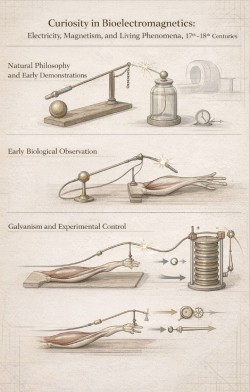
In the 17th and 18th centuries, the physical mechanics of electricity and magnetism were intelligently grasped through applicable demonstrations of attraction effects - sparks, electric shocks and the properties of magnets. Experiments with charged objects and the rudimentary electrostatic apparatus demonstrated that even if you do not see the cause, this thing called “force at a distance” can still be made re-occurs. This was important because it increased the possibility that the living organism might also be formally investigated.
Following these research advances, it became evident that animals could exhibit behaviors that would in reality be generated electrics to outsiders although there electricity was not resolvable which was a clear source of attraction. These notes were not explicitly coherent in their theories of the time, but they formed a basis of later work in the field: the idea that the body’s response can be studied, from being unobservable to being observable, reversibly and irreversibly evoked, as an active ensemble of reactions rather than being passive and descriptive.
Galvanism, Batteries, and the Value of Control
Late eighteenth-century experiments, often associated with “animal electricity,” helped move discussion from anecdote toward testable setups. Whether a twitching muscle implied an intrinsic electrical property or an effect induced by external contact became a central dispute. Importantly, the dispute itself pushed scientists to specify materials, timing, and geometry in ways that later became standard experimental habits.
The early battery, especially Volta’s pile, then changed the practical landscape. A controllable source of current meant researchers could vary intensity and duration rather than relying on unpredictable static charges. That shift from spectacle to adjustable input is a key step in the prehistory of bioelectromagnetics: it made electrical interaction with tissue something that could be systematically probed.
The Nineteenth Century: Electrophysiology Becomes a Measurable Science
During the nineteenth century, the study of nerves, muscles, and organs became increasingly tied to measurement rather than interpretation alone. Laboratories began to treat electrical signals as quantities that could be detected, amplified, and recorded. This was also the era when specialized instruments turned “invisible” physiological events into traceable marks, encouraging new kinds of questions about timing, pathways, and mechanisms.
Standard Experiments and the Rise of Reproducibility
Early electrophysiology often relied on simple readouts such as muscle contraction, but researchers worked to make these readouts more dependable. Protocols became more explicit about how tissue was prepared, how electrodes contacted it, and how stimulation was applied. Even small methodological details mattered, because they affected whether results could be repeated in another laboratory.
This emphasis on reproducibility helped separate broader theoretical claims from what could be supported by direct observation. It also encouraged the idea that biological electrical behavior was not a curiosity limited to certain animals or organs. Instead, it could be investigated as a general feature of excitable tissue, with patterns that might be compared across species and experimental conditions.
Instruments That Translated Biology into Traces
A major driver of progress was instrumentation, including devices designed to detect very small voltage changes. Galvanometers and later refinements allowed researchers to connect tissue activity to measurable deflections, shifting attention toward signal magnitude and time course. Once signals could be “seen” through instruments, they could also be argued about with new precision.
Graphical recording techniques reinforced that shift. Recording transformed fleeting events into stable artifacts: lines on paper that could be measured, shared, and reanalyzed. This did not eliminate disagreement, but it changed its character. Arguments increasingly focused on calibration, noise, and experimental setup, themes that remain central in bioelectromagnetics research today.
Organ-Level Signals and Early Bioelectric Frameworks
As measurement improved, researchers explored electrical activity in organs with rhythmic or coordinated function, especially the heart and nervous system. Even when mechanisms were debated, the act of measuring organ-level signals created a framework where physiology could be described in electrical terms: timing, conduction, and patterns of activation.
This era also produced early conceptual bridges between physics and physiology. Researchers began treating tissue as having properties that could be modeled, such as resistance and conduction pathways, without assuming that organisms were “just circuits.” The lasting contribution was methodological: it became normal to ask what physical descriptions can capture about living systems, and where those descriptions fall short.
Twentieth-Century Foundations: Engineering, Theory, and New Research Settings
In the early twentieth century, bioelectrical research matured alongside rapid advances in physics and engineering. Electromagnetic theory offered a shared vocabulary, while new devices improved sensitivity and stability. The field’s evolution was shaped not only by ideas, but also by where research happened: hospitals, industrial laboratories, and university departments with distinct priorities and tools.
Electromagnetic Theory as a Common Language
As electromagnetic theory became widely taught and applied, it provided researchers with concepts for describing fields, currents, and material properties more rigorously. This mattered for biology because it supported clearer distinctions between what was being applied to tissue (a field, a current, a pulse) and what was being observed (a voltage change, a waveform, a threshold response).
Theory also encouraged modeling as a companion to experiment rather than a separate activity. Researchers could propose simplified representations of tissue to estimate how electrical phenomena might distribute through organs and fluids. Even when models were crude by modern standards, they helped clarify assumptions and encouraged experiments designed to test specific physical expectations.
Recording Technologies and the Shift toward Noninvasive Observation
Except for certain fields such as cardiology, the clinical impact or benefits of bioelectromagnetics is minimal. The ability to record non-invasively has enabled the collection of big data sets and using standard electrodes placements became feasible as well.
In this applications of such methods, the excitation of the cardiovascular system due to the generated electromagnetic energy will mostly be insignificant and, therefore, this concept is expected to be proven in the model for use in experimental conditions by means of appropriate procedures. As for other twentieth-century biomedical advances, available tools for naturally peaceful purposes were secondarily targeted.
Post-War Expansion: Methods, Standards, and the Practicalities of Measurement
After World War II, research capacity expanded dramatically, and electronics became more advanced, affordable, and widely distributed. This period is often remembered for growth in laboratories and funding, but its deeper importance lies in the infrastructure of measurement: shared methods, better control of experimental conditions, and more explicit attention to how results could be compared across sites.
- Wider access to stable amplifiers, oscilloscopes, and signal generators that made controlled stimulation and recording easier
- Better shielding and grounding practices, including dedicated rooms and improved cabling, to reduce environmental interference
- Early computational and statistical tools that supported more systematic analysis of complex signals
- Increasing focus on calibration, reporting details, and reference measurements to support comparability
- Growth of journals, conferences, and professional networks where methods could be critiqued and refined
- Early steps toward exposure characterization and dosimetry concepts, framed as measurement problems rather than conclusions
As these practices spread, the field’s questions began to shift. Researchers increasingly asked not only “does a response occur?” but “under what precisely described conditions can we measure it, and how confident are we that it is biological rather than instrumental?” That transition toward methodological self-scrutiny strongly influenced what later became recognizable as modern bioelectromagnetics research.
Becoming a Field: Interdisciplinary Bioelectromagnetics (1970s–1990s)
By the late twentieth century, research on electromagnetic interactions with living systems had grown large enough to require clearer definitions, specialized communities, and shared technical language. Biology, physics, engineering, and medicine increasingly overlapped, often because the same experiment demanded expertise in instrumentation, tissue preparation, and modeling. The most visible change was organizational, but the deeper change was conceptual: the field’s identity formed around methods and questions rather than any single technique.
Naming, Organizing, and Debating Scope
As the topic gained dedicated journals and professional societies, “bioelectromagnetics” became a useful label rather than a retrospective description. Naming helped coordinate research by signaling what counted as relevant: not only bioelectric signals generated by organisms, but also how externally applied fields and electromagnetic environments could be characterized and studied in biological contexts.
This organizational growth also forced recurring boundary debates. What belongs in the field: electrophysiology, magnetobiology, exposure assessment, computational modeling, instrumentation design? These debates were productive because they clarified that the field’s unity comes from shared measurement challenges and multi-scale reasoning, from molecules and cells to tissues and whole organisms.
Models, Dosimetry, and the Push for Comparability
As studies multiplied, comparability became a practical concern. Researchers needed ways to describe exposures and experimental conditions precisely enough that another lab could reproduce them. This encouraged the development of dosimetry and modeling practices that linked external conditions to internal quantities that matter for interpretation, such as induced currents or field distributions in tissue.
Modeling also became more sophisticated as computing improved. Instead of treating tissue as a simple uniform material, models could incorporate geometry, conductivity differences, and boundary effects. The historical significance is that models increasingly shaped experimental design: they helped researchers decide what to measure, where to measure it, and how to interpret complex interactions without relying on vague descriptions.
Molecular Biology and the Re-Scaling of Questions
The field of bioelectromagnetics has been significantly challenged by the arrival and ascendancy of cellular and molecular biology. This influenced the biological, and biophysical landlords, who traditionally controlled the core of the science. The basis of new electromagnetics, however, was established with radiation that is nomadically random and does not have a sense of direction which controlled all the research, development and design work brought about by the communicable research work on animal and human bodies. It is obvious that under these new conditions any experimental research project not centered falls into the category of mania or mere disorientation. Rather, there is the normal type of research of many questions about which standard solutions are to draw graphics to find a curve.
Modern Research Frameworks and Why the Past Still Matters
Contemporary bioelectromagnetics is best understood as a set of research practices spanning multiple scales, from physical field characterization to biological measurement and computational interpretation. New tools continue to reshape what can be observed, and therefore what questions feel realistic. Looking back across the field’s history highlights a consistent theme: advances often come from better measurement and clearer definitions, not from bolder conclusions.
Quick Links
⚠️ WATCH CAREFULLY! THIS IS WHAT YOUR PHONE DOES TO YOU EVERY DAY!
— VAL THOR (@CMDRVALTHOR) November 21, 2025
How many of you carry your phone in your pocket?
How many sleep with it next to your head?
If you knew what your body is absorbing…
you’d think twice.
In the video, the EMF meter explodes into RED the second… pic.twitter.com/B3BlT0oKg7
With the kind support: