Natural Electromagnetic Fields Around Earth
In simple terms, an electromagnetic field is an area in which both electric and magnetic forces may be experienced. Depending on the situation, the field can be static similar to holding a magnet consistently; and at other times, it can be dynamic, which enables the connection of electricity and magnetism in such a way that energy is transported through the field.
There is a wide variety of natural electromagnetic fields. Some are extremely limited lasting for a very short period of time and they typically show up as a short burst of electricity mostly associated with the lighting of a given area. Others are very long lasting and consist of rather planetary fields such as the magnetic field that covers the Earth and the lacae of the Earth's charged particles laws to the other known as space.
Earth’s Magnetic Field and the Invisible Compass
Earth behaves like a giant magnet, with a field that extends far beyond the atmosphere. This field is generated largely by moving molten metal deep in the planet, which acts like a natural electrical system. At the surface, it is strong enough to guide compasses and influence how certain animals navigate.
Farther out, Earth’s magnetic field shapes a larger region often described as a protective bubble that interacts with charged particles arriving from the Sun. Those particles follow the field’s structure rather than moving in straight lines. This interaction is one reason auroras appear near the poles, where the geometry of the field guides particles downward.
Atmospheric Electricity and Lightning
The atmosphere is not electrically quiet. Even on calm days, there is an ongoing separation of charge between the ground and higher layers of the air, influenced by weather systems and global atmospheric processes. That separation sets up electric fields that can vary with humidity, cloud formation, and local conditions.
Lightning is the most dramatic example of atmospheric electricity. Within storm clouds, collisions among ice and water particles can sort charge into different regions. When the electric field becomes intense enough, a rapid discharge occurs, briefly creating extremely strong fields and bright emission across parts of the electromagnetic spectrum.
Sunlight and Solar Activity as Everyday Electromagnetism
Sunlight is electromagnetic radiation, meaning it is energy traveling through space as linked electric and magnetic waves. The light we see is only a small slice of a broader spectrum that includes infrared heat and ultraviolet radiation. Our daily rhythms, plant growth, and the warmth we feel outdoors are tied to this constant natural input.
The Sun also produces changing magnetic activity that can stir conditions in near Earth space. Streams of charged particles and shifting solar fields interact with Earth’s magnetic environment, sometimes producing stronger auroras and measurable changes in the upper atmosphere. Most of the time this is noticed only indirectly, through the way it affects the space around us rather than anything at ground level.
Electric Power and the Fields Behind the Grid
When people talk about EMFs in daily technology, they often mean the fields linked to electricity generation and use. Electric power systems rely on moving electric charges through conductors, and moving charges create magnetic fields. When the current changes over time, the surrounding fields change too.
Alternating Current and Why Fields Appear Around Wires
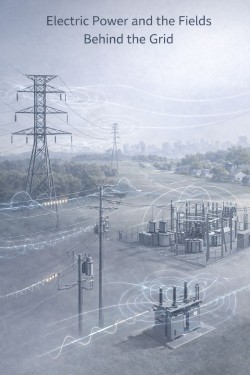
Whenever current flows through a wire, a magnetic field forms around it. With alternating current, that magnetic field strengthens, weakens, and reverses in step with the current’s rhythm. At the same time, the voltage on a conductor creates an electric field that extends into the space around the wire.
In everyday settings, these fields are usually most noticeable as a concept rather than something you can sense directly. The important functional point is that power delivery is not just electricity inside metal. It is a system where electrical and magnetic effects exist both within the conductors and in the surrounding space.
Transformers, Substations, and the Work of Moving Energy
Electric power systems as an Engineering discipline deals with the generation, transmission, distribution, utilization, and control of electrical energy. Electrical power systems are regulated more than any other field. Government regulations usually dictate transmission and distribution line spans, service territories, and communication practices. is an interdisciplinary area that includes one or more subfields or branches of engineering, such as chemical engineering, civil engineering or industrial engineering; Although the theory and principles of economics and business administration can be used within this area it is not pure economic or management science.
EMFs Inside Homes and Workplaces
In buildings, EMFs come from two main sources. One is the fixed wiring that distributes power to outlets, lights, and larger equipment. The other is the devices that convert electrical energy into motion, heat, light, sound, or information, each with its own internal patterns of current and voltage.
Wiring, Circuits, and the Background Field of a Building
Building wiring carries current whenever something is operating. Even when a device is off, parts of a circuit can still be energized depending on how it is wired and switched. That means electric fields can exist around certain conductors, while magnetic fields tend to track more closely with active current flow.
Circuit design also affects how fields spread. Wires routed close together can cause some magnetic effects to partially balance, because currents moving in opposite directions create opposing magnetic patterns. This is one reason many wiring systems are arranged as paired conductors rather than single isolated runs.
Appliances and Electronics as Field Generators
Many household appliances rely on motors, which use magnetic fields to create rotation. Fans, refrigerators, washing machines, and power tools all use electromagnetism to turn electrical energy into motion. Heating devices use current flow through resistive elements, which also produces surrounding fields as the current runs.
Smaller electronics add another layer because they often convert power using fast switching circuits. Phone chargers, laptop power supplies, and many modern devices reshape incoming electricity into stable internal voltages. That reshaping is an electromagnetic process happening at higher frequencies than basic power delivery, even though it is usually hidden behind plastic cases and compact components.
Wireless Communication and the Airwaves
Wireless systems use electromagnetic waves to carry information without a physical wire between sender and receiver. Instead of pushing current through a cable to a distant device, a transmitter creates a changing electric and magnetic pattern that travels outward. A receiver then converts part of that arriving energy back into an electrical signal.
Broadcast Radio and Long Range Signals
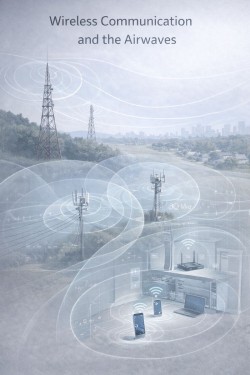
Traditional radio and television broadcasting uses large antennas to send signals over wide areas. The basic idea is simple. A transmitter varies a carrier wave in a controlled way, and that variation encodes sound or video information. The wave spreads through space and can be picked up by receivers that are tuned to the right frequency.
Because these signals are meant to cover regions, their infrastructure is often placed on towers, rooftops, or high terrain. The engineering challenge is to send a stable signal while limiting interference with nearby channels. The electromagnetic field pattern around an antenna is shaped by its geometry and by the ground and structures near it.
Mobile Networks, WiFi, and Short Range Links
A cell phone system is made up of a large number of base stations that handle via handover procedures the mobility of phones as they move around various areas. Each base station is in charge of using its own distinct radio frequencies and time slots in order to handle many calls at a go. The phone can beam; it can remove or amplify its light based on network demands and signal strength.
Wi-fi and Bluetooth are commonly used in short range applications that are generally within the confines of a structure or a room. They compromise on coverage to provide faster services within the premises hence use methods like multiple access channels that allocate rooms every few minutes to various types of devices. In animate things, even the most basic tasks – like turning on the phone or connecting the headset – are front lines in a battle of wavelength forces select and carried any information, the wave acting being energy-efficient and implemented so that chances remain extremely low.
Transportation, Infrastructure, and Urban Environments
Cities add layers of electromagnetic activity because they concentrate power systems, communications, and electrically driven machines in a small area. Rail systems, elevators, and building services run large currents, while streets are filled with signals used for navigation, control systems, and connectivity. The result is not one single field, but many overlapping fields that vary by place and time.
- Electric rail and tram power equipment
- Traffic lights and control cabinets
- Elevators and building mechanical systems
- Electric vehicle charging hardware
- Tunnels, stations, and their communication systems
Infrastructure also shapes how fields behave. Metal structures can guide and shield electric effects, while open spaces allow signals to spread differently. The same subway line can look electromagnetically different above ground versus underground, simply because the environment changes how currents return and how waves reflect.
Medical and Scientific Uses of Electromagnetic Fields
Medicine and research use EMFs as tools because fields can interact with matter in predictable ways. Sometimes the goal is to image internal structures without surgery. Other times it is to measure electrical signals produced by the body or to analyze materials in a lab. The unifying theme is control, where instruments generate or detect fields with specific properties.
MRI and Magnetic Fields as an Imaging Tool
Magnetic resonance imaging uses strong magnetic fields and carefully timed radio frequency pulses. The strong magnet aligns certain properties of atoms in the body, and the radio pulses briefly disturb that alignment. When the atoms relax back, they produce signals that can be detected and converted into detailed images.
Sensors, Diagnostics, and Research Instruments
Many diagnostic tools measure electrical activity directly. Electrocardiograms and electroencephalograms detect tiny voltage changes at the skin that reflect coordinated activity in the heart and brain. These signals are not transmitted through the air as radio waves. They are local electrical phenomena that instruments capture and interpret.
When the Invisible Feels Familiar
Upon deducing the source of electromagnetic fields as from a thunderstorm to an electrical socket and then to cordless facilities, various aspects that merge together to form electromagnetic fields is seen rather that the topic constituting one thing only. Each element is associated with electricity and magnetism as long as there is change in the presence of charges, voltage is radiated and energy travels. Whether we are attentive or not, we live in this region every other day.
Quick Links
⚠️ WATCH CAREFULLY! THIS IS WHAT YOUR PHONE DOES TO YOU EVERY DAY!
— VAL THOR (@CMDRVALTHOR) November 21, 2025
How many of you carry your phone in your pocket?
How many sleep with it next to your head?
If you knew what your body is absorbing…
you’d think twice.
In the video, the EMF meter explodes into RED the second… pic.twitter.com/B3BlT0oKg7
With the kind support: