What Is Bioelectromagnetics?
Bioelectromagnetics is a discipline that investigates interactions of fields developed around electrical circuits with living cells. A special characteristic of it is that biological research is based on physical measurements which in turn allow fine measurements of the organisms or materials for research purposes. It is a discipline that discriminates between what is known and what has to be tested, things that can be measured and things that cannot be measured rather than trying to decide whether something is good or bad.
Where the Idea Comes From
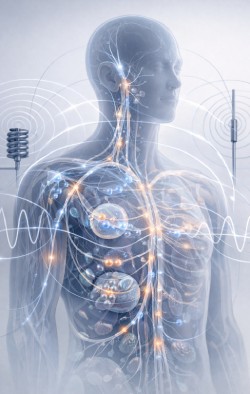
Electromagnetic theory describes how electric and magnetic forces behave and how energy moves through space. Biology describes how cells and tissues function, including electrical activity in nerves and muscles. Bioelectromagnetics starts at the overlap because living matter is full of charged particles and moving ions, so in principle it can couple to external fields.
The term is modern, but the ingredients are older. Physiologists have long measured electrical signals in the body. Engineers have long modeled fields around conductors and antennas.
What the Field Studies and What It Leaves Out
Bioelectromagnetics studies how exposure is defined, how fields enter or affect tissue, and what biological responses can be measured under controlled conditions. Some questions are about basic physics in tissue, like induced currents at low frequency or energy absorption at higher frequency. Other questions test whether small changes in cells or behavior repeat reliably.
It also has limits. A surprising result is not treated as a fact until it can be reproduced. Personal reports can point to hypotheses, but they are not enough on their own.
Why Exposure Measurement Is Central
With a chemical, dose can often be weighed or counted. With a field, exposure depends on frequency, strength, distance, orientation, and time. It also depends on the body, since tissues differ and the body can act like a complex conductor.
For that reason, bioelectromagnetics spends a lot of effort on dosimetry. That work estimates internal fields or absorbed energy rather than only what a meter reads in the air. Without that step, it is hard to compare studies.
Electromagnetic Fields in Everyday Life
People often hear “EMF” as if it were one single thing. In practice it is a shorthand for a wide spectrum of fields and waves. Understanding the basic categories helps keep the topic factual and avoids mixing unlike exposures.
Natural Background Fields
The Earth’s magnetic field is a constant feature of the environment. Atmospheric electricity varies, especially during storms. Sunlight is electromagnetic radiation at much higher frequencies than most man made sources, and it is central to warmth, vision, and plant life.
Natural does not automatically mean safe, and familiar does not mean harmless. Still, background conditions are useful as reference points when researchers compare newer sources with different patterns.
Common Human Made Sources
Power systems generate low frequency electric and magnetic fields around wiring, appliances, and transmission lines. Communications systems generate higher frequency fields from broadcast antennas and from nearby devices that transmit. Many exposures are intermittent, changing with use, location, and network conditions.
A person’s exposure can rise and fall across a day with routines like commuting or working near equipment. That variability is one reason why broad labels often fail.
Frequency and Energy Without the Hype
Frequency is how fast a field oscillates. Low frequency fields change slowly. High frequency fields change quickly and can travel as waves. Frequency is linked to wavelength, which describes the spacing of the wave pattern.
Energy is often misunderstood. Some electromagnetic radiation is ionizing, meaning it can break chemical bonds. Many everyday technologies use non ionizing frequencies, where the best established interaction in tissue is heating when power is high enough and exposure lasts long enough.

How Living Systems Interact With Electromagnetic Fields
An interaction can be as simple as a tiny current induced in tissue or as familiar as heating from absorbed energy. Bioelectromagnetics looks for mechanisms that make physical sense and for biological endpoints that can be measured consistently. It also treats biology as noisy by default, so study design matters as much as the hypothesis.
The Body as an Electrical System
Cells maintain voltage differences across their membranes. Nerves and muscles use rapid electrical changes to communicate and contract. Blood and other fluids carry ions, which means tissue can conduct electricity to some degree.
External electric fields can push charges. Changing magnetic fields can induce small currents. A key research question is scale, meaning whether induced effects are large enough to matter compared with the body’s own signals and normal variability.
Heating and Absorption
At higher frequencies, energy can be absorbed and converted into heat. The size of the temperature rise depends on intensity, duration, and where the energy concentrates. Tissue is not uniform, so absorption can vary across regions.
Heating is not automatically harmful. The body manages temperature constantly. The scientific issue is whether an exposure could cause a meaningful local rise or interfere with regulation.
Non Thermal Ideas and Why They Are Hard
Researchers have investigated some phenomena whose causes are not solely due to the increment in temperature as in cell transduction, or in oxidation. It is far from easy to analyze such studies as various other factors normally interact with the same quantities, for example, exogenous stress, light intensity, rest, dietary schedule.
If the data reasonably justifies an explanation, convincing is it and the pattern is consistent across studies that have different designs. On the other hand, if the results are not reproducible, it is possible that the measurements included hidden biases, or underestimated the influence of the factor under review.
A Field at the Intersection of Disciplines
Bioelectromagnetics exists because the question crosses boundaries from the source of a field to the biology that might respond. Researchers often need both engineering tools and biological methods in the same project. That mix can slow progress, yet it also keeps conclusions tied to measurement.
- Physics provides the basic description of fields and waves and the equations used to model exposure.
- Biology provides understanding of cells, tissues, signaling, and the ways organisms regulate themselves.
- Medicine provides clinical context, including monitoring of organs and controlled uses of fields in imaging and stimulation.
- Environmental science provides real world exposure scenarios and population level ways to study trends.
Much of the field is about building shared definitions so results can be compared honestly.
Why Bioelectromagnetics Matters
Field biology is an integral aspect of life, the contemporary trends of which every caring citizens need to be keen in. It doesn’t stop there, research supports better questions, more appropriate assessment of risks, and prevention of diseases for the recently developed field based technologies. It also promotes field-use in research and biomedical applications only where necessary.
Improving Public Health Evidence

Population studies can look for associations between exposure patterns and health outcomes. They are useful for generating hypotheses, especially when exposure is widespread and long term. Their limits are also real because exposures can be hard to estimate and many factors can confound results.
Bioelectromagnetics helps by tightening exposure models and by identifying which metrics fit a given frequency range. Better exposure classification can reduce disagreement between studies and make null results more meaningful.
Informing Standards and Testing Methods
Guidelines for exposure depend on what is known about coupling to tissue and on where effects become plausible. They also rely on conservative assumptions because uncertainty remains in parts of the evidence base. That is a technical process built on measurement, modeling, and review.
Research contributes by improving test setups, making models more realistic, and clarifying which effects are well established and which are still being debated.
Supporting Controlled Medical Uses
Electromagnetic fields are used deliberately in medical imaging and in some forms of stimulation of nerves and muscles. In these settings, parameters are measured, exposure is controlled, and outcomes are monitored. That combination makes it easier to link cause and effect than it is in everyday exposure.
These applications also show why context matters. A brief, high intensity exposure in a clinical device is not the same scenario as low level background exposure.
Clarifying Common Terms and Misconceptions
The hardest disagreements in this topic often start with vocabulary rather than data. Words like radiation and dose have technical meanings, but they are used loosely in everyday speech. Clear terms do not settle every question, yet they make it easier to see what a study does and does not claim.
Radiation Is Not One Category
Radiation means energy traveling through space. It includes visible light, infrared heat, radio waves, and higher energy forms such as X rays. Using the word without specifying the type can make ordinary exposures sound more alarming than they are.
Many discussions about consumer electronics involve non ionizing radiation. That does not mean “risk free,” but it does mean the relevant mechanisms differ from those of ionizing radiation.
Exposure, Dose, and Specific Absorption Rate
Exposure describes the field outside the body. Dose is what is induced or absorbed in the body. The two are related but not interchangeable, and the gap between them can be large depending on frequency and geometry.
For some radiofrequency studies, researchers estimate specific absorption rate, often called SAR, to describe how quickly energy is absorbed by tissue. Other contexts use internal electric field strength or induced current as the main metric.
Correlation and Causation in Different Study Types
Epidemiology can detect patterns in large groups, but it struggles to rule out confounding factors completely. Laboratory studies can control variables, but they may use simplified exposures that do not match daily life. Neither approach is perfect.
Confidence grows when multiple methods point in the same direction and when results replicate. When they do not, the responsible conclusion is uncertainty and a clearer description of what the data can support.
Common Shortcuts That Mislead
Two shortcuts show up often. One is the assumption that natural equals safe and human made equals harmful. Another is the idea that any measurable biological change must matter for health. Biology changes constantly, and not every change has consequences.
Bioelectromagnetics tries to avoid these shortcuts by focusing on realistic exposure levels, plausible mechanisms, and endpoints that connect to function.
Seeing the Invisible Environment
Bioelectromagnetics is a way of studying an environment that people cannot sense directly. It treats electromagnetic exposure as something that can be measured, modeled, and tested like other physical factors. That framing helps move the topic away from slogans and toward evidence.
The Main Ideas to Keep
Electromagnetic fields are part of nature and part of technology. Living systems rely on electrical processes, so interaction is plausible in principle. Some interactions are well understood, especially induced currents at low frequency and heating at higher frequency when power is sufficient. Many other questions remain, and the quality of conclusions depends heavily on exposure characterization and replication. The writing here aims for plain, journalistic clarity and avoids hype.
Where Research Often Goes Next
Progress usually looks like better measurement and better study design. Researchers refine models of how fields distribute in tissue, develop sensors that capture real life exposure more accurately, and agree on protocols that make replication possible. Over time, those steps make it easier to judge which reported effects are robust and which fade with stronger controls.
The Science of the Unseen
The study of bioelectromagnetics is known to be focused on investigating the interaction between electromagnetic fields and living organisms using experimental observation and biological analysis rather than making mathematical calls on the subject. It touches on the various levels of spatial and time exposures – from natural magnets of the epoch till the current man-created ones often connected with energy or communications facilities.
Quick Links
⚠️ WATCH CAREFULLY! THIS IS WHAT YOUR PHONE DOES TO YOU EVERY DAY!
— VAL THOR (@CMDRVALTHOR) November 21, 2025
How many of you carry your phone in your pocket?
How many sleep with it next to your head?
If you knew what your body is absorbing…
you’d think twice.
In the video, the EMF meter explodes into RED the second… pic.twitter.com/B3BlT0oKg7
With the kind support: